


Fujimoto. Complete Works 1994–Today. Art Edition No. 1–200, ‘The Grand Ring’
Also available:

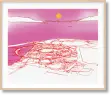
This Art Edition (No. 1–200) includes the signed four-color silkscreen The Grand Ring, a large-format print of an original iPad sketch by Sou Fujimoto for Expo 2025 Osaka in Japan. It is accompanied by the numbered hardcover volume, Fujimoto. With a cover made of pure white Japanese paper, the front of the book features a two-layer blind embossing that depicts the wooden structure of Fujimoto’s monumental Expo Ring. The monograph is placed in a custom-designed box with fine wooden veneer of cypress, which opens to the right, like a Japanese publication, and is made of cypress, the same wood that Fujimoto used for the Grand Ring in Osaka.
With in-depth case studies of key works, including the Serpentine Gallery Pavilion, L’Arbre Blanc, and the House of Music in Budapest, this is a complete portrait of an architect who is unafraid to “dismantle architecture to its limits.”
“I like to think about the whole history, and then, to imagine how we can think about the architecture of the future. Everything is connected, everything is related.”
Fujimoto. Complete Works 1994–Today. Art Edition No. 1–200, ‘The Grand Ring’
1750Living Spaces
Sou Fujimoto's nature based architecture
Dissolving the boundaries between nature and design, between order and uncertainty, between inside and outside, Sou Fujimoto is a daringly original voice in architecture. This monograph traces his career and explores his ideas, influences, and achievements. Working from studios in Tokyo and Paris, he draws inspiration not just from the great architectural canon, but from the natural world, quantum physics, and the complexities of human interaction. He aims to create spaces that feel at once elemental and radically new.
Completed with an overview of his oeuvre, all his landmark projects are described in detail, including House N, House NA, and the Musashino Art University Museum & Library in Tokyo, the House of Music in Budapest, and the monumental Grand Ring for Expo 2025 Osaka.
At the heart of Fujimoto's ‘Primitive Future’ philosophy lies a fascination with ambiguity, imperfection, and possibility. Educated as much by Japanese concepts of in-between space as by the revolutionary thinking of Einstein or his heroes Gaudo, Le Corbusier, and Mies Van Der Rohe, he imagines architecture as a living framework for experience.
Whether he’s creating cloud-like structures from steel grids, as with his Serpentine Gallery Pavilion, or an apartment block with living spaces that extend like branches into the sky, as in L'Arbre Blanc, Fujimoto's buildings invite people to discover new relationships with one another and their surroundings. With an in-depth introduction and commentary, this is the most complete portrait yet of an architect who is totally unafraid to challenge every convention, to “dismantle architecture to its limits.”
This Art Edition (No. 1–200) includes the four-color silkscreen, The Grand Ring, a large-format print of an original iPad sketch by Sou Fujimoto for Expo 2025 Osaka in Japan. It is accompanied by the numbered hardcover volume, Fujimoto. With a cover made of pure white Japanese paper, the front of the book features a two-layer blind embossing that depicts the wooden structure of Fujimoto’s monumental Expo Ring. The monograph is placed in a custom-designed box with wooden veneer of cypress, which opens to the right, like a Japanese publication, and is made of cypress, the same wood that Fujimoto used for the Grand Ring in Osaka.
The artist
Sou Fujimoto is a key figure in new Japanese architecture. He has continuously eliminated barriers between architecture and the natural environment. Fujimoto takes inspiration from natural structures such as caves, forests, and nests to create his own unique architecture, which he refers to as the Primitive Future. Born in 1971, he founded his own firm in 2000.
The author
Philip Jodidio studied art history and economics at Harvard and edited Connaissance des Arts for over 20 years. His TASCHEN books include the Homes for Our Time series and monographs on numerous major architects, including Norman Foster, Tadao Ando, Renzo Piano, Jean Nouvel, and Zaha Hadid.
Fujimoto. Complete Works 1994–Today. Art Edition No. 1–200, ‘The Grand Ring’
Edition of 200Four-color silkscreen, on 305 gsm Hahnemühle Photo Rag Ultra Smooth paper, 61 x 50 cm; hardcover volume in a custom-designed box with wooden veneer of cypress, 30.8 x 39 cm, 464 pages, total weight 13 kgISBN 978-3-8365-9322-9
Edition: Multilingual (English, French, German)No reviews have been posted for this item yet. Be the first to rate this product.